Fonny Proposes to Tish and Asks Joseph for His Blessing
If Beale Street Could TalkFonny’s proposal to Tish and request for Joseph’s blessing turn a private declaration of love into a family decision. Arriving at the Rivers home after a night together, Fonny does not leave Tish at the door or let her invent an explanation for their late return. He asks to speak with Joseph, announces that he and Tish want to marry, and accepts the scrutiny of the family he calls his own. Joseph’s eventual welcome makes the scene more than a request for paternal permission: it becomes a recognition of the couple’s long bond and a charge to take responsibility for one another.
The Arrival at the Rivers Home
Fonny brings Tish home at seven on Sunday morning. They have traveled uptown together, held each other on a nearly empty subway, and walked through their neighborhood hand in hand. At the stoop, Tish expects him to leave; instead, he takes her hand and leads her upstairs. That choice begins the proposal’s public, familial dimension. He is not content to make a promise privately and leave Tish to account for herself afterward.
Ernestine opens the door in an old bathrobe. Her first look is stern, but she smiles and invites them in for coffee. Tish starts to speak, apparently searching for an excuse, while Fonny addresses the situation directly: “Want to get married,” he says. His abruptness changes the meaning of their arrival. The household had reason to worry about Tish’s absence, and Sharon says they had nearly begun calling the police. Seeing Fonny beside Tish relieves her: his presence means that Tish has not returned alone, and that the situation is not the one Sharon feared.
Fonny apologizes to Sharon for keeping Tish out late and takes responsibility for it. He says that he had not seen her for several weeks and that they had a great deal to discuss. When Sharon asks whether that is all they had been doing, he does not retreat from the purpose of his visit. He says again that they want to marry, then explains that he loves Tish, had tried seeing other girls, and had returned because he could not make himself love anyone else. The proposal follows a period of distance, but his account presents that distance as a failed attempt to escape a commitment he still recognizes.
Fonny Makes His Case
When Joseph enters the kitchen, he first addresses Tish’s late return and insists that living in his house requires respecting its rules. Fonny then lets go of her hand and stands. Rather than leaving Tish to bear the accusation, he asks Joseph not to scold her and says that keeping her out was his responsibility. He identifies himself as the person who asked her to marry and explains that he has come because Joseph is her father. The request is personal, but it also acknowledges the place Joseph holds in Tish’s life.
Fonny is twenty-one. Asked whether that is old enough to marry, he admits that he does not know, but says it is old enough to know whom he loves. When Joseph asks whether he is sure, Fonny straightens and answers that he is. His certainty is not based on a claim that marriage will be easy. He describes the work he does to support himself, loading moving vans during the day, and the work he pursues at night as a sculptor. He says he knows the future will be difficult, but believes he is a real artist and may become a great one. His proposal therefore joins an emotional promise to an account of the life he is trying to build, without pretending that he already has the security that life will require.
The exchange remains tense. Joseph asks whether Fonny came to inform him or seek his permission; Fonny has not touched his coffee, and the two men repeatedly measure one another. When Joseph asks what Fonny would do in his place, Fonny trembles. He says that he would ask his daughter, and that if she did not love him, he would leave and not trouble the family again. The answer makes the proposal contingent on Tish’s choice rather than a demand for Joseph to settle the matter on her behalf. His hand briefly touches Tish’s shoulder and moves away; his nervousness is visible, but it does not make him withdraw his request.
Tish States Her Choice
Joseph turns from Fonny to Tish and asks whether she loves him and wants to marry him. Tish answers yes, repeating it before explaining what her answer means. She says that she is her father’s daughter and her mother’s daughter, and that her yes is deliberate. She wants Joseph’s permission because she loves him, but makes clear that she is choosing to marry Fonny, not asking her father to choose a husband for her. Her response holds affection and independence together: his blessing matters to her, yet her decision is her own.
That distinction gives the family’s approval its proper limits. Fonny asks for Joseph’s blessing out of respect, and Tish values that respect, but neither treats the marriage as Joseph’s decision alone. The proposal becomes mutual in the kitchen: Fonny has offered his commitment, Joseph has tested what it entails, and Tish has made her own intention unmistakable. Joseph sits down after her answer. His response suggests that the confrontation has shifted from whether the couple is serious to how the family will receive a choice they have both made.
Joseph’s Acceptance and the Family Bond
After speaking with Fonny in another room, Joseph returns with him and calls them both crazy, while acknowledging that there is nothing he can do about it. His reluctant smile softens the earlier anger. He recognizes that someone was bound to take Tish away one day, though he had not expected it so soon, and observes that she and Fonny have been together since childhood and are no longer children. His acceptance is not simply a concession to a sudden request; it rests on the history he sees between them and on Fonny’s willingness to face him openly.
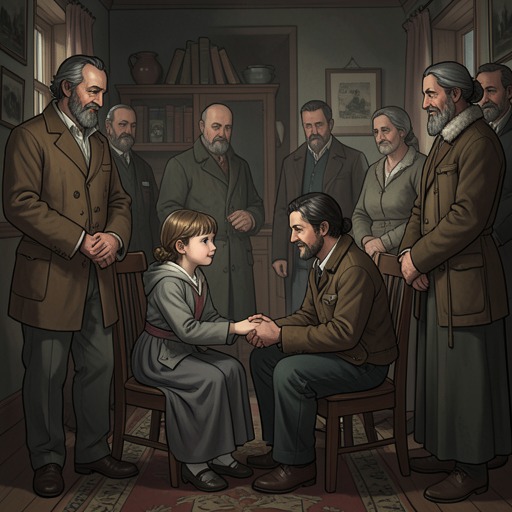
Joseph takes Fonny by the hand, leads him to Tish, then takes Tish’s hand and brings her to her feet. He places her hand in Fonny’s and tells them, “Take care of each other.” The gesture makes the blessing tangible: Joseph joins the couple rather than merely saying that he approves. His instruction also replaces the question of permission with an ongoing obligation. They are to discover for themselves how demanding that care will be.
Fonny has tears in his eyes and kisses Joseph. He says he must go home to tell his father, then turns back to Tish and kisses her across the space between them. He expects his father to be happy and arranges for the couple to return to the Rivers home around six that evening. Joseph agrees, now smiling openly. The planned return carries the news beyond this first family conversation and gives the proposal a next step, while the scene itself closes with both fathers’ place in the young couple’s plans acknowledged.
Significance Within the Relationship
The proposal marks a change from private love to an acknowledged family commitment, but the scene does not reduce commitment to the words “I love you.” Fonny must account for his absence, his conduct, his means of support, and his artistic ambitions; Tish must state her decision before the family; Joseph must reconsider his protectiveness in light of the couple’s history. Each person’s position changes through a distinct act: Fonny takes responsibility, Tish asserts her choice, and Joseph gives his blessing.
The exchange also establishes care as reciprocal rather than possessive. Fonny does not ask Joseph to hand Tish over as though she were his to give; he asks what Joseph would do in his place, and accepts that Tish’s answer is decisive. Tish, in turn, seeks her father’s permission because their bond matters to her, without surrendering her authority over her own marriage. Joseph’s joined-hands gesture gathers those positions into a family promise. His final instruction is not a guarantee that the future will be easy, but the clearest expression of what he expects the marriage to require.